


TRANSPORTATION
New cashless payment system launched for MRT-3
MANILA, Philippines – Commuting on the MRT-3 just got easier and faster. The Department of Transportation (DOTr), in partnership with various government agencies and the private sector, launched new cashless payment methods on the rail line today.
This initiative is a direct response to President Ferdinand Marcos Jr.’s directive to improve commuter services through digitalization, aiming to provide a more comfortable and hassle-free travel experience for passengers.
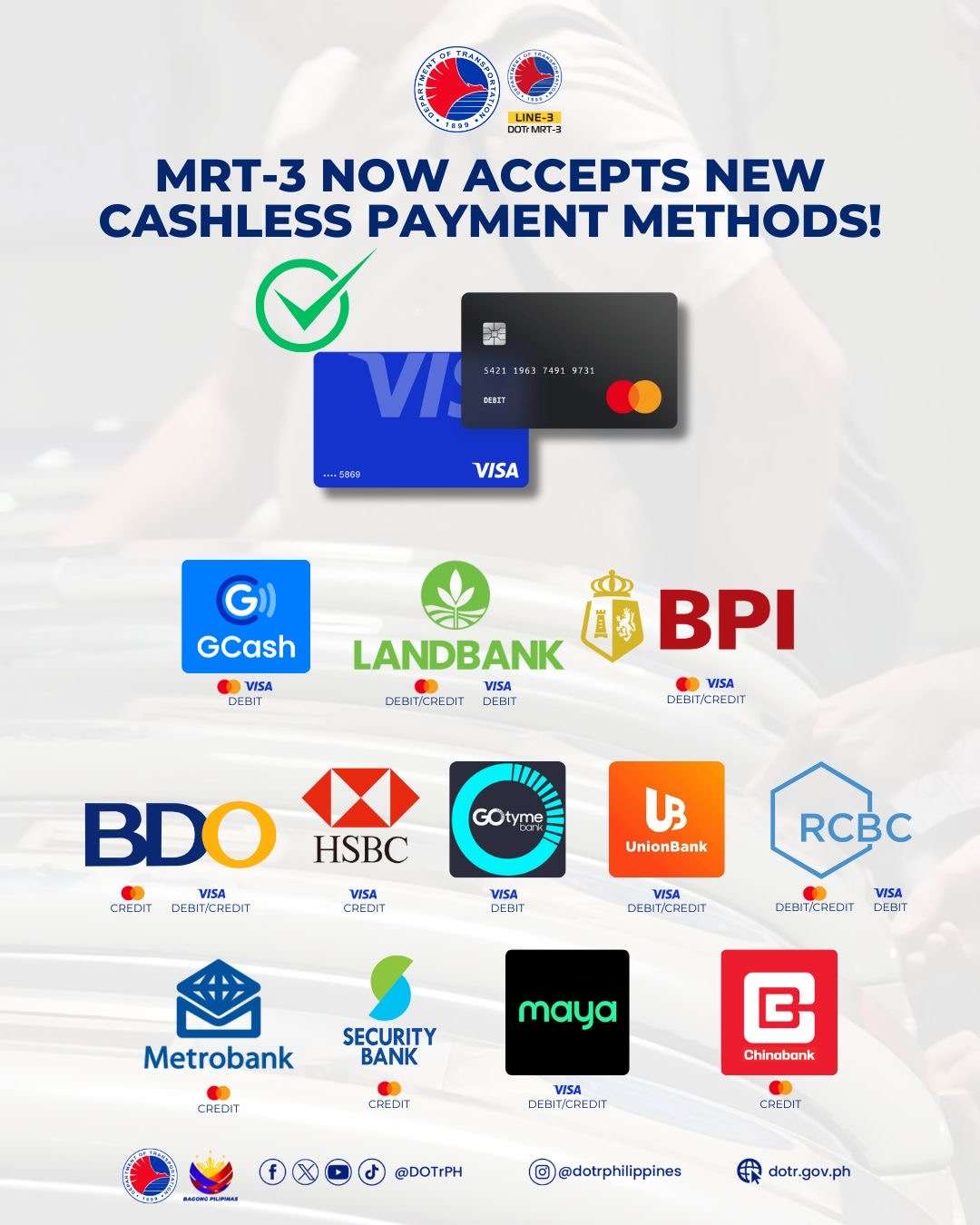
Transportation Secretary Vince Dizon explained that with the new system, passengers can now ride the train by simply tapping their GCash Commuter QR Code, an Android cellphone with Near Field Communication (NFC) enabled, or a debit or credit card at the turnstiles.
“There’s no additional charge to the fare here. The system will deduct the same amount from your GCash, credit card, or debit card as it would if you bought a single journey ticket,” Secretary Dizon stated at the MRT-3 Ayala Station.
He added that passengers no longer need to queue at ticket counters to buy single journey tickets (SJT). They can now proceed directly to the turnstiles and pay using the cashless option.
This integrated payment setup is touted as a “first of its kind” globally due to its unique “multiple fare media” capability. Unlike typical cashless payment systems that only use EMV and transport cards, the MRT-3’s new setup can accept NFC and QR codes, all within a single payment terminal.
“This is the first of its kind in the whole world. Almost all payment modes are possible in one device. This is what the President is pushing us to do to make the travel experience convenient,” the Secretary emphasized.
Secretary Dizon acknowledged the crucial support from partners including the Bangko Sentral ng Pilipinas (BSP), Department of Information and Communications Technology (DICT), Department of Trade and Industry (DTI), Landbank, G-Cash, VISA, and KentKart in making this possible.
These cashless payment options are also slated for implementation on LRT-1 and LRT-2 in the coming months, with RCBC as a key partner for those expansions.