


TSUNAMI ALERT
Massive quake off Russia triggers tsunami waves, evacuations in Japan, Hawaii
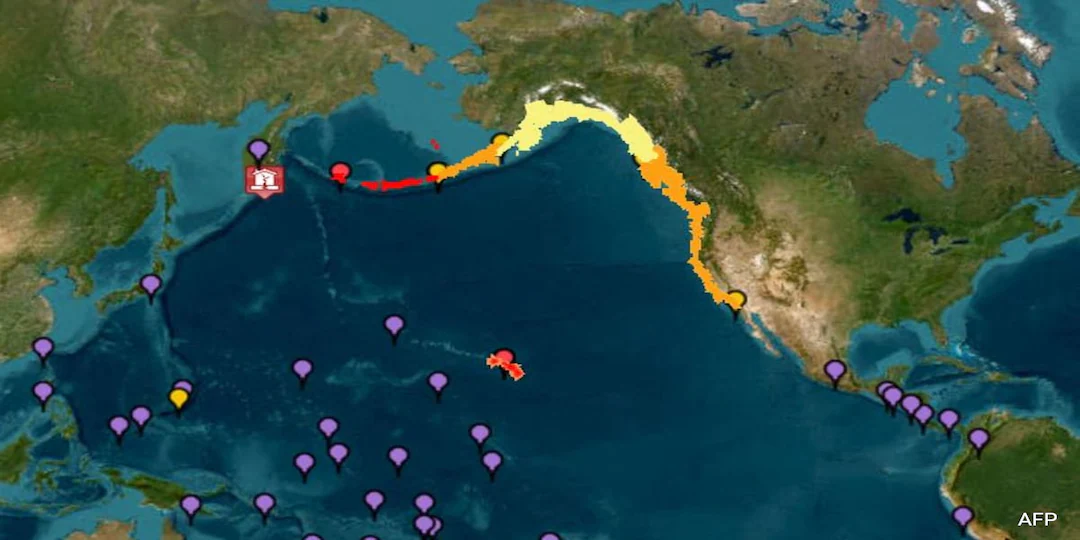
One of the strongest earthquakes ever recorded, an 8.8-magnitude tremor, struck Russia’s Far East early Wednesday, sending tsunami waves across the Pacific and prompting widespread warnings and evacuations from Russia to Japan, Hawaii, and Alaska. While no substantial widespread damage has been reported so far, authorities urged coastal residents to remain vigilant as the risk of further waves could persist for more than a day.
The powerful undersea quake, initially reported as an 8.0 by Japanese and U.S. seismologists before being upgraded to 8.8 by the U.S. Geological Survey (USGS), struck at 8:25 a.m. Japan time. Its epicenter was located approximately 119 kilometers (74 miles) east-southeast of Petropavlovsk-Kamchatsky, a city on Russia’s Kamchatka Peninsula. Multiple aftershocks, some as strong as 6.9 magnitude, followed the initial seismic event.
Immediate Impacts and Evacuations:
In Russia, ports on the Kamchatka Peninsula experienced flooding, and residents fled inland. The Kuril Islands, a territory disputed by Russia and Japan, were particularly affected, with a state of emergency declared. The fishing port of Severokurilsk on the Kuril Islands reported several tsunami waves topping 3 meters (9.8 feet), cutting power supplies to the area. Initial reports from Russian authorities indicated several injuries, though no specific figure was provided.
Japan, still recovering from the devastating 2011 earthquake and tsunami, saw frothy, white waves wash ashore in its northern regions. A tsunami height of 60 centimeters (2 feet) was recorded on Hokkaido, Japan’s northern island, and later a 1.3-meter (4.3-foot) wave reached Iwate Prefecture. Over 1.9 million people across 21 prefectures were advised to evacuate, with many seeking refuge in evacuation centers. Notably, no abnormalities were reported in the operations of Japan’s nuclear power plants. At least one injury was reported in Japan.
Pacific-Wide Alert:
The tsunami waves propagated across the Pacific, triggering warnings and advisories in numerous regions:
- Hawaii: Sirens blared across Honolulu, urging residents to seek higher ground. Cars jammed streets and highways as people evacuated coastal areas. The first waves reached Hawaii, with a 1.2-meter (4-foot) wave recorded off Oahu. Hawaii Governor Josh Green advised residents to heed evacuation orders and remain calm, while U.S. President Donald Trump urged Americans to be on alert.
- Alaska: Tsunami advisories were issued for Alaska’s Aleutian Islands, where waves up to 30 centimeters (1.4 feet) above tide levels were observed.
- U.S. West Coast: The National Tsunami Warning Center, based in Alaska, issued tsunami advisories for parts of California, Oregon, and Washington.
- Canada: A tsunami advisory was also issued for much of the coast of British Columbia.
- Other Regions: Tsunami alerts of varying levels were issued for the Philippines, Indonesia, Guam, Peru, and the Galapagos Islands off Ecuador.
Authorities continue to monitor the situation closely, emphasizing that tsunami events often involve a series of waves, and the danger can persist for many hours. Residents in affected coastal areas are urged to stay away from shorelines and follow official instructions.