

US-PH RELATIONS
Marcos returns to PH after ‘productive’ US trip
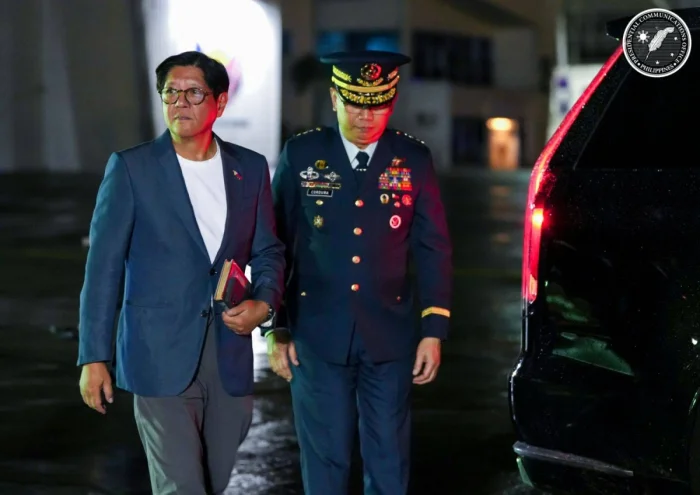
President Ferdinand Marcos Jr. returned to the Philippines on Wednesday night, July 23, concluding a three-day official visit to Washington D.C. that he described as “productive,” highlighted by key meetings with US President Donald Trump and other American officials.
The chartered flight carrying the chief executive and his delegation landed at Villamor Air Base past 10 p.m. In his arrival statement, President Marcos emphasized the reaffirmation of the longstanding alliance between the Philippines and the United States. “We reaffirmed our mutual commitment to further strengthening our longstanding alliance and growing our economies for the benefit of the people and in pursuit of our national interests,” Marcos stated. He added that discussions included regional and international security issues, focusing on bilateral cooperation to address common challenges.
During his bilateral meeting with President Trump, Marcos expressed gratitude for the US’s “consistent support for the preservation of regional peace and stability and for upholding the rule of law in the South China Sea.” Other areas of mutual interest discussed by the two leaders encompassed cybersecurity, energy supply resilience, and critical infrastructure.
President Marcos also underscored the importance of multilateral engagement with neighboring countries to reinforce regional alliances. He welcomed the US government’s pledge of an additional $15 million for private sector development under the Luzon Economic Corridor Initiative and an additional $48 million in foreign-assisted projects, noting that the Philippines will continue to work with the State Department and US Congress for their implementation.
Trade deal and economic outlook
A central outcome of the visit was the new trade deal announced by President Trump, which sets a 19 percent tariff rate on Philippine goods exported to the US, while US goods will face zero tariffs upon entering the Philippines. This 19 percent duty, effective August 1, is a slight reduction from the 20 percent Trump had threatened earlier this month, though it remains higher than the initial 17 percent rate announced in April. Despite this, the new rate is the second-lowest in the region, surpassed only by Singapore’s 10 percent.
President Marcos described the revised 19 percent rate as a “significant achievement.” “Now, one percent might seem like a very small concession. However, when you put it into – in real terms, it is a significant achievement,” he told reporters in Washington before his departure. He expressed optimism for further discussions on tariff rates and trade deals with the US.
Under the new agreement, the Philippines will scrap tariffs on US automobile imports, opening that market. Marcos also indicated that the Philippines would increase imports of US soy products, wheat, and pharmaceuticals, a move he believes will help lower medicine prices in the country. Philippine Ambassador to the United States Jose Manuel Romualdez echoed this sentiment, calling it “an evolving good deal for both countries that could be further improved over time.”
President Trump lauded Marcos as a “very good and tough negotiator” and expressed confidence that the “very big numbers” in the trade agreement would continue to grow. The US had a trade deficit of nearly $5 billion with the Philippines last year on bilateral goods trade of $23.5 billion. The US remains a vital export destination for the Philippines, accounting for nearly 16% of its total exports, including semiconductors and electronic products, in the first five months of the year.